Tuesday, November 27, 2007
Project Proposal 2

Friday, November 16, 2007
Stalingrad
Questions
- What does Joseph Stalin's advice to the people of Stalingrad say about him as a leader?
- Explain why Hitler would react in the way shown after signing a Non-Aggression Pact with Stalin?
- Explain the significance of propaganda in this battle, using examples from the posters.
- What do the extremes of the war reveal about what it takes to win a total war?
- How does the story of Vasily Zaitsev relate to the war in Iraq?
- In times of crisis, sometimes heroic figures emerge. Which figure emerged in a similar way to Vasily after the terrorist attacks of 9/11?
Answers
- He is unforgiving, and very cruel. He doesn't really care about people, even his own.
- He reacted this way because he knew that Stalin couldn't send his troops after him, even though they both broke the pact. He also acts this way because he wants to fight a one front war.
- The Propaganda played a big role because it demoralized the Germans. If there is a sign that says "Kill the Fascists!!" then it will make you feel worthless if you are a fascist.
- According to this: to win a total war you have to do whatever you have to, and lay siege to important places.
- Vasily Zaitsev's story relates to the Iraq war because he was a determined fighter just as we fight Osama Bin Laden, who also is very determined to win no matter the cost.
- The fireman because they were the ones that went in and saved people from the crumbling towers.
Thursday, October 18, 2007
Exam 2
The thing that changed the world the most in history was the Columbian Exchange. The Columbian Exchange was the exchange of animals, food, and other materials into Europe. The Columbian Exchange also instituted the Triangle Trade, which traded slaves for goods, and goods for more commodities. The motivation behind the Triangle Trade was mostly because of the demand for goods. The economics of this time were based on the social impacts. All of these factors effect history and the way we see the Columbian Exchange.
Wednesday, October 17, 2007
Book Portfolio....Hunger

What happens when people who don't eat all the time, get fed? Or what happens when people who normally eat, are starved? The answers are drastically different. When people who don't usually eat, or are fasting for a long time and their body's kind of reject the food. When food enters someone who hasn't eaten in a while the body doesn't remember what to do with it. In one test, the man who was starved for 30 days threw up he food he was given because it was "too much" even though it was a simple serving size. The people who eat everyday and are starved have psychological effects and physical effects. Most people will lose weight. Others however will change their daily routine or have emotional breakdowns. Some people would freak out at the simplest questions. Either way both have great effects on the body.
You see someone in a box, not moving, meditating, they haven't eaten in 24 days; in your mind you wonder " Why"? People fast for many different reasons. As mentioned above people starve themselves to lose weight, get in touch with them inner selves, and to reach out and find god. Everyone has their own reasons.
To conclude, this book was pretty boring. It was fascinating, but dragged out. The author definitely got her theme across and was very descriptive in some parts. I learned a lot from this book, and I figured I wouldn't be fasting anytime soon.
Thursday, September 27, 2007
Essay Question
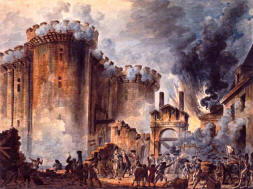 This is the storming of Bastille. This was important because it was the biggest step against the king. In this I got that even the commoners can fight against the king. This also shows that the king was not ready and did not foresee and overthrow.
  The guillotine was a big part in the French Revolution because it killed more than 40,000 people that were accused of being unloyal to the king. This also relates to the Committee of Public Safety because it was they who ruled France during the revolution for a short period of time.
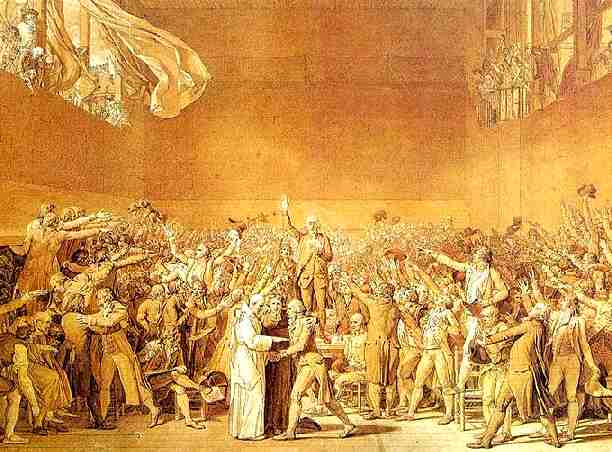 This is the Tennis Court Oath. This is significant because it was to establish the constitution in the realm of France. This also created a sense of safety and peace throughout the people. The Tennis Court Oath was a big part in the French Revolution because it made a base for the new kingdom.
From these 3 pictures you can tell that the French Revolution was very bloody. You can also see that middle class people wanted to be equal and have rights, and that people wanted to overthrow the king to restore peace.
